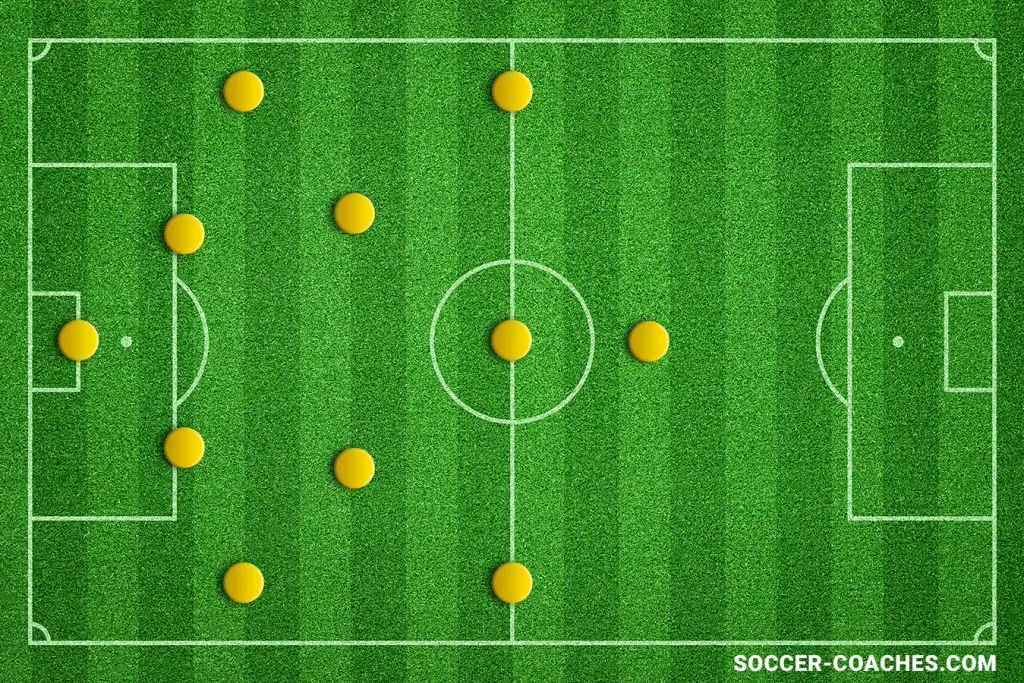
Football tactics are the hidden engine behind every great match, every surprise upset, and every “how did they win that?” moment that fans talk about for days.
If you’ve ever watched a game with friends and heard someone say, “Bro, it’s just running and passing,” you probably laughed… but deep down you knew the truth. Football is chess at full speed. It’s planning, space, timing, and decisions made in seconds.
I still remember one match where my favorite team had more possession, more shots, and louder fans—but still lost 2–0. At first, it felt unfair. Later, after watching highlights again, it became obvious: the other team didn’t beat us with talent. They beat us with a smarter plan.
That’s what tactics do. They don’t replace skill, but they multiply it.
This guide is written for fans who want to understand the game without needing a coaching license. It’s friendly, simple, and real—based on what you actually see on the pitch, not just fancy diagrams.
Why Tactics Matter More Than Star Players
A world-class player can change a match. But a world-class system can control the entire season.
Teams win trophies because they repeat good patterns every week. They know how to press, when to sit deep, how to overload a side, and how to defend transitions. These are tactical habits, not luck.
Even in street football, you’ll notice tactics. One team spreads wide. Another sits compact. Someone stays back to stop counters. That’s tactical thinking in its simplest form.
At the professional level, it becomes sharper and more detailed.
That’s why fans who understand tactics enjoy football more. You stop watching only the ball—you start watching the whole picture.
Football tactics Explained in the Simplest Way
Let’s make this easy.
Tactics are basically a team’s plan to do three things:
How to attack
How to defend
How to move between the two
That “move between” part is where most games are won or lost. It’s called transition play, and it’s the reason counter-attacks feel so deadly.
A good tactical team knows what to do when they win the ball and what to do when they lose it. No panic. No confusion. Just automatic movement.
And when that movement is repeated perfectly, it looks like “chemistry.” But it’s actually structure.
Formations Are Just the Starting Shape (Not the Full Story)
Most fans talk about formations like they’re the whole identity of a team.
4-3-3
4-2-3-1
3-5-2
4-4-2
But here’s the truth: formations are only a starting point.
A team might defend in a 4-4-2 and attack in a 3-2-5. Another team might start in a 4-2-3-1 but shift into a 2-3-5 when they have the ball.
This is why you sometimes look at a lineup graphic and feel confused during the match. You’re not wrong—the team is changing shape constantly.
So instead of asking, “What formation are they playing?” ask, “What shape are they attacking and defending in?”
That question gives you real insight.
The Three Main Tactical Phases You Should Watch
Every match has three repeating phases:
When a team has the ball
When a team doesn’t have the ball
When the ball changes possession
In possession, the key question is: how do they create chances?
Out of possession, the key question is: how do they stop chances?
In transition, the key question is: how fast and smart do they react?
If you start watching football like this, you’ll understand why some teams look “dominant” even without scoring. They’re controlling the phases.
And the best teams control all three.
Pressing: The Tactic Fans Love the Most
Pressing is one of the most talked-about modern strategies.
Pressing means applying pressure high up the pitch to win the ball back quickly. It’s aggressive, exciting, and it can completely suffocate an opponent.
But pressing isn’t just “run and chase.” It’s organized.
Good pressing uses triggers like:
A bad first touch
A back pass
A slow pass to the fullback
A goalkeeper receiving under pressure
When the trigger happens, the whole team jumps together. That’s the difference between smart pressing and chaos.
If only one player presses alone, it’s easy to pass around. But when three or four press as a unit, the opponent feels trapped.
Pressing is risky, though. If the opponent breaks it, the defense is exposed.
That’s why pressing teams need fast defenders and midfielders who can recover quickly.
Low Block vs High Line: Two Different Ways to Defend
Some teams defend deep. Some defend high.
A low block means the team stays compact near their own box, protecting space behind them. It’s hard to break down, especially when done with discipline.
A high line means the defense pushes up near midfield, squeezing the pitch and reducing space. It’s great for controlling possession and keeping pressure, but it’s vulnerable to long balls and fast forwards.
Neither is “wrong.” It depends on players, opponent, and match situation.
A smaller team might choose a low block to survive. A dominant team might choose a high line to control the game.
Sometimes teams switch mid-match, especially when protecting a lead.
The Midfield Battle: Where Matches Are Quietly Won
Most goals start in midfield.
That’s why the midfield area is a tactical war zone. Coaches design systems to win control there because once you control midfield, you control the tempo.
Some teams use a single pivot midfielder to build play. Others use a double pivot for safety. Some push an attacking midfielder into half-spaces to overload.
If you’re wondering what to watch in midfield, focus on:
Who receives the ball under pressure
Who turns and plays forward
Who breaks lines with passes
Who wins second balls after clearances
Midfielders who do these things well don’t always get highlights, but they decide games.
And when a midfield collapses, even the best strikers look invisible.
Wide Play and Overloads: Why Fullbacks Matter So Much
Modern football is obsessed with width.
Wingers stretch the pitch. Fullbacks overlap or invert. Teams create overloads on the wings to pull defenders out of shape.
An overload happens when one side has more attacking players than defending players. For example, a winger, fullback, and midfielder combining against two defenders.
Once the defense is overloaded, one of two things happens:
A cross comes in
A cutback finds a free runner
Cutbacks are especially dangerous because defenders usually face their own goal and can’t react quickly.
If you’ve ever seen a goal where the ball is pulled back to the penalty spot and slammed in, that’s a classic overload-to-cutback pattern.
It looks simple. But it’s designed.
Inverted Fullbacks: The Tactic That Changed Everything
One of the biggest modern trends is the inverted fullback.
Instead of staying wide, the fullback moves inside into midfield during build-up. This creates extra passing options and helps the team control the center.
It also protects against counter-attacks because the fullback is already in a central position when the ball is lost.
When done well, it makes the team feel like they have an extra midfielder.
When done badly, it leaves the wing open and creates chaos.
This tactic works best when the team has a winger who can hold width alone.
So next time you see a fullback drifting into the middle, don’t assume they’re lost. They’re following a plan.
Counter-Attacks: Fast, Direct, and Deadly
Counter-attacking is one of the most effective strategies in football.
It’s not just “kick it long and run.” It’s structured speed.
Counter-attacking teams usually defend compact, invite pressure, and then explode forward when they win the ball.
The key ingredients are:
A quick first pass forward
Runners sprinting into space
A decision-maker who can pick the right option
Some teams counter with long balls. Others counter with short combinations. But the goal is the same: attack before the opponent resets.
This is why losing the ball in midfield can be fatal. It’s the most dangerous area for turnovers.
When a team is caught with fullbacks high and midfielders spread out, the counter is basically a free chance.
Set Pieces: The Tactical Weapon People Underestimate
Set pieces are not luck. They’re rehearsed routines.
Corners, free kicks, and throw-ins can decide matches, especially in tight games.
A well-coached team will have:
Planned runs and blocks
Target zones in the box
Second-ball setups outside the area
Variations to confuse markers
If you watch closely, you’ll notice players pointing, signaling, and moving in patterns before the ball is even kicked.
That’s training ground work.
Some teams win entire seasons by being elite on set pieces. It’s not flashy, but it’s powerful.
And in knockout football, it’s often the difference.
Football tactics in Big Matches: Why Coaches Play Safe
Big games feel different because the risk level changes.
In a normal league match, teams might press high and attack freely. But in a big derby or a Champions League knockout match, coaches often choose control over chaos.
That’s why big matches sometimes start slow. It’s not boring. It’s tactical caution.
Both teams are testing each other. They’re looking for weak spots. They’re trying not to make the first mistake.
Then one moment breaks the pattern: a mistake, a red card, a counter, or a set piece goal.
After that, tactics shift quickly.
The team that’s behind becomes aggressive. The team that’s ahead becomes compact.
And the match becomes a tactical story, not just a physical battle.
How to Read Tactical Changes During a Match
If you want to look like the smartest fan in the room, watch for these signs:
A winger suddenly starts playing narrower
A fullback stops overlapping
A midfielder drops deeper between center-backs
A striker stops pressing and blocks passing lanes instead
The team starts switching play faster from side to side
These are clues that a coach has adjusted something.
Sometimes the change is forced by an injury. Sometimes it’s a planned second-half switch.
But these small shifts can completely change the match.
That’s why good managers don’t just pick a formation—they manage the game live.
The Most Common Tactical Mistakes Teams Make
Even strong teams make tactical errors, and when they do, it’s painful to watch.
One common mistake is pressing without compactness. The front line presses, but the midfield stays back. That creates a huge gap that opponents exploit easily.
Another mistake is attacking with too many players and leaving no protection. When possession is lost, the counter is unstoppable.
Some teams also become predictable. They always attack down one side, always cross early, or always pass sideways.
When a team becomes predictable, even weaker opponents can defend comfortably.
The best teams stay unpredictable. They can attack wide, attack central, play direct, or slow the game down.
That flexibility is tactical maturity.
Why Fans Should Care About Tactics (Even If You’re Not a Coach)
You don’t need to be a coach to enjoy tactical football.
Understanding tactics helps you appreciate:
Why a player looks “bad” in one system and great in another
Why possession doesn’t always mean control
Why one substitution changes everything
Why a 1–0 win can be more impressive than a 4–2 win
It also makes match discussions more fun.
Instead of arguing “he’s trash,” you start saying “his role doesn’t suit him” or “the spacing is wrong.”
That’s a smarter way to talk football.
And honestly, it makes you a better fan because you see the full picture.
How I Started Understanding Tactics as a Regular Fan
I didn’t learn tactics from a textbook.
I learned from watching matches twice.
The first time, I watched like a fan—celebrating, shouting, reacting.
The second time, I watched highlights and focused on movement off the ball. I noticed how midfielders positioned themselves, how fullbacks timed runs, and how pressing traps were created.
After a few weeks of doing that, football looked different.
The game slowed down in my mind. I started predicting passes before they happened. I started seeing why teams were struggling.
That’s the power of tactical awareness.
You don’t need to memorize everything. You just need to start noticing patterns.
Simple Tactical Questions to Ask While Watching Any Match
To keep things practical, ask yourself these questions while watching:
Which team is controlling space, not just possession?
Who is creating overloads and where?
Are the fullbacks staying wide or moving inside?
Is the pressing organized or random?
What happens right after the ball is lost?
When you ask these questions, the match becomes more than entertainment.
It becomes a story of decisions.
And that’s what makes football addictive in the best way.
The Future of Football Tactics: What’s Coming Next
Tactics keep evolving.
More teams are focusing on build-up patterns from the goalkeeper. More teams are using hybrid defenders who can step into midfield. More teams are using flexible forwards who swap positions constantly.
The game is becoming faster and smarter.
And as data improves, tactical planning becomes sharper too. Coaches now study pressing efficiency, passing lanes, and transition speed like never before.
But even with all that technology, the heart of tactics stays the same: space and timing.
Football will always be about finding space and protecting space.
Read also:
india national football team standings
netherlands national football team vs poland national football team lineups
france national football team vs croatia national football team lineups
guadeloupe national football team vs guatemala national football team stats
